Home • Study English Abroad • Study Abroad in Ireland
Study Abroad in Ireland
Your guide to language schools, universities, and high schools. Get free advice on visas, work rights, and navigating the Dublin accommodation market.
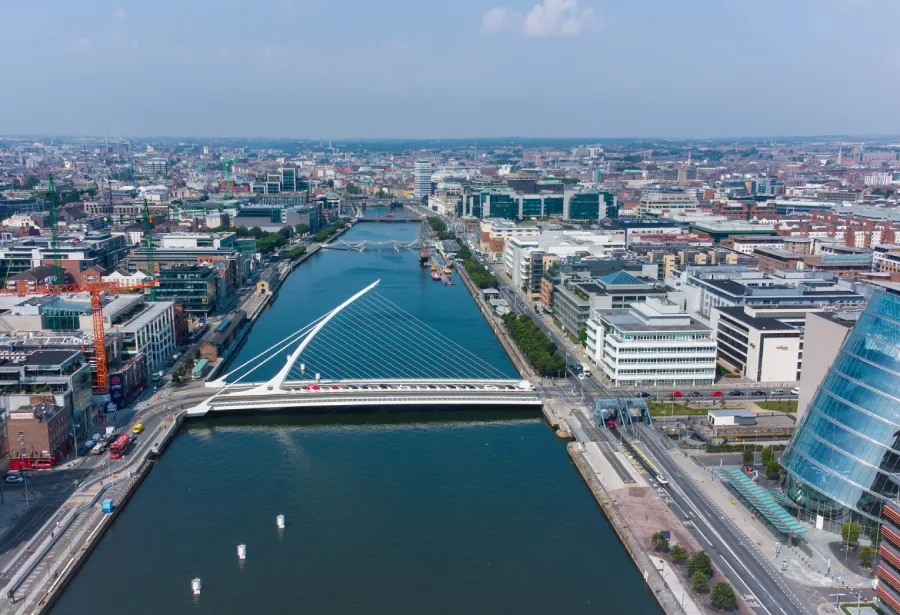
Why study abroad in Ireland? Ireland is famously a welcoming country with a strong tradition of education, friendly people, and a rich cultural identity. When you choose to study abroad in Ireland, you are choosing the only native English-speaking country in the EU. It is a top choice for students who want high-quality education combined with an easy-going lifestyle and the ability to travel freely across Europe.
Which Irish city is right for you? Ireland has a city for every lifestyle, from the fast-paced capital of Dublin to the vibrant, cultural hub of Galway.
- Dublin: The capital, a historic city that is now a major hub for global tech companies.
- Galway: A “bohemian” and artistic city on the west coast, known as Ireland’s cultural heart.
What is the international student experience like in Ireland? Ireland offers a strong balance between academic focus and a relaxed, welcoming lifestyle. It is known for being student friendly, with a vibrant international community supported by easy travel across the EU. English schools can be found in both lively cities and smaller cultural centres, making it a great choice for students who want a sociable environment without the scale of larger English-speaking countries.
If you are just starting your research and want a complete overview of the entire process, from understanding the benefits to planning your trip, read our complete guide to English language study abroad.
Key Takeaways
- EU vs. Non-EU Rules: Italian (EU) students have freedom of movement. Japanese and Korean (Non-EU) students do not need a visa before arrival but must register for an Irish Residence Permit (IRP) after arriving.
- Critical Housing Crisis: Finding accommodation, especially in Dublin, is extremely difficult. You must start your search 3–4 months early to avoid scams.
- Work Rights: Non-EU students can work while studying Ireland (part-time), but only if enrolled in a 25+ week course on the official ILEP list.
- Post-Study Work: The “Third Level Graduate Scheme” is for university graduates only, not language students.
Irish visas for international students
Types of Visas in Ireland for All International Students
The Ireland student visa system is unique and depends entirely on your citizenship and the length of your course.
Visa Pathway | Length | Work Rights? | Best For |
Visitor Visa / ETA (600/601) | < 3 Months | NO | Short-term “taster” language courses. |
Student Visa (Subclass 500) | > 3 Months | YES (Part-time / 48hrs fortnight) | Long-term, full-time academic or language study. |
Working Holiday Visa (417) | Up to 1 Year | YES (Full-time) | Work, travel & study (up to 4 months). |
For Italian (EU/EEA) Students
As an EU citizen, you have the right to study in Ireland for any duration without a visa. You have the same rights as an Irish citizen to work and live, making this the easiest and most flexible option.
For Japanese & South Korean (Non-EU) Students
Citizens of Japan, South Korea and other Visa Waiver countries, do not need to apply for a visa before traveling, but must register for an Irish Residence Permit (IRP) after arriving for courses longer than 90 days. This is a “post-arrival registration” system. For courses under 90 days, you can enter as a tourist. Check this link for a full list of Visa Waiver countries in Ireland.
Exam “Tie-In" Rule (Visa Condition)
For Non-EU students on a long-term (25+ week) course, taking an external exam (like IELTS or Cambridge) at the end of your course is mandatory. It is a condition of your student visa.
The Irish Residence Permit (IRP) and ILEP Schools
To get your Irish Residence Permit (IRP), you must be enrolled in a full-time course (minimum 15 hours/week) at a school on the official Interim List of Eligible Programmes (ILEP). Your school will provide the letter you need for your registration appointment.
Always check the official rules at the Irish Immigration Service.
Cost of studying and living in Ireland
Cost of Studying and Living in Ireland for International Students
The cost of studying in Ireland can be expensive for international students, especially in Dublin where limited housing availability has pushed accommodation costs up significantly. This has a major impact on overall affordability and is an important factor to consider when planning your budget.
Estimated Tuition Fees
Tuition fees in Ireland are competitive, but can vary depending on the city and institution. Below are estimated annual fees for international students. English language schools are typically billed weekly.
Type of School | Estimated Tuition Fee (EUR) |
English Language Schools | €160 – €600 per week |
Elementary Schools | €7,000 – €14,000 per year |
High Schools | €9,000 – €28,000 per year |
Universities | €12,000 – €30,000 per year |
Vocational Schools (College) | €9,000 – €15,000 per year |
Note:
Fees are estimates and vary by institution, city, and program. University fees for specialized degrees like medicine can be significantly higher.
Estimated Cost of Living
Your total budget must account for the high cost of rent, especially in Dublin, which is one of the most expensive cities in Europe for accommodation. Below is an estimated monthly budget for a single international student, comparing Dublin to the more affordable city of Galway.
Expense Category | Estimated Monthly Cost (EUR) |
Accommodation (Shared) | €1,000 – €2,000 |
Food & Groceries | €300 – €500 |
Transport (Public) | €40 – €70 |
Utilities & Phone | €105 – €230 |
Total Estimated Monthly | €1,445 – €2,800 |
Work rights in Ireland
Working While Studying in Ireland for International Students
Work rules for international students in Ireland depend on citizenship and course length: EU students can work full-time, while Non-EU students on a long-term (25+ week ILEP) course can work part-time (20 hours/week during term, 40 hours/week during holidays), but work is not permitted for short courses of 90 days or less.
To be legally paid, a Personal Public Service (PPS) Number is required after getting a job offer and an Irish Residence Permit (IRP), and the post-study work scheme is only available to university degree graduates, not language students.
Visa / Student Type | Work Rules | Study Limit |
EU Student (ex: Italy) | Yes (Full-time). No restrictions. | No limit. |
Non-EU (Stamp 2 Visa) | Yes (Part-time). 20 hours/week (term) & 40 hours/week (holidays). | Must be a 25+ week ILEP course. |
Non-EU (Short Course) | No. Not permitted. | Must be 90 days or less. |
PPS Number (Personal Public Service Number)
To work in Ireland, you need a PPS Number (Personal Public Service Number). You can only apply for this after you have a job offer and your IRP card. It is essential to avoid paying ’emergency tax’ (which is very high). You cannot get paid without one.
The Post-Study Work Availability in Ireland
It is critical to know that the “Third Level Graduate Scheme” (Stamp 1G) is only for non-EU students who graduate from a Level 7 or higher degree program, not an English language course. This scheme allows eligible graduates to stay and work in Ireland for 12-24 months, making it an excellent pathway for university students.
Healthcare and insurance
Healthcare and Health Insurance in Ireland for International Students
Ireland has a two-tiered healthcare system for students, depending on whether you are an EU citizen or a non-EU international student.
If you are from the EU/EEA, you generally have access to public healthcare. If you are from a non-EU country (like Japan or South Korea), you are responsible for your own private insurance, which is a mandatory requirement for immigration registration.
Student Origin | Requirement | Type of Cover | Estimated Cost |
Non-EU (Year 1) | Mandatory | Basic “Travel” style medical insurance (hospital only). Required for IRP registration. | €160 – €200 / year |
Non-EU (Year 2+) | Mandatory | Often requires “Ordinary Residence” private medical insurance (more comprehensive). | €500 – €1,200 / year |
EU / EEA | Optional | Public access via EHIC card. Private insurance is optional for faster access. | Free (Public) / Varies (Private) |
For Non-EU International Students
You must purchase private medical insurance to register with immigration. When you arrive in Ireland, you must register with Immigration Service Delivery (ISD) to get your Irish Residence Permit (IRP). To do this, you must show proof of private medical insurance.
- First Year: You can typically use a cheaper “student travel insurance” policy (often around €160) that covers accidents and emergencies in hospitals.
- Second Year Onwards: If you stay longer, you are considered “ordinarily resident” and may need to upgrade to a more comprehensive (and expensive) Irish private health insurance plan.
For EU/EEA International Students
European students can access public healthcare using their EHIC. If you have a European Health Insurance Card (EHIC), you are entitled to “necessary healthcare” in the public system for free or at a reduced cost. However, many students still choose to buy private insurance to avoid long waiting times.
Public Transportation
Public Transportation Rules and Costs in Ireland
Public transport in Ireland is reliable and cost-effective for students, thanks to a unified “smart card” system and generous fare caps. Whether you are in Dublin using the tram (Luas) and bus, or in Galway using regional buses, the system is integrated.
Feature | Details | Key Benefit |
Payment Method | TFI Leap Card | Works on Bus, Train (DART), Tram (Luas) nationwide. |
Student Discount | Young Adult (19-23) or Student (24+) | 50% Discount on all fares nationwide. |
Fare Capping | Automatic weekly/daily limits | Unlimited travel after you hit the cap (e.g., ~€32/week). |
90-Minute Fare | Dublin Area | Free transfers between bus/tram/train within 90 mins. |
The TFI Leap Card
This is the single most important card for getting around in Ireland. The TFI Leap Card is a contactless smart card valid on buses, trains, certain ferries, and the Luas tram. Using it is always cheaper than paying cash (usually 30% cheaper).
Young Adult and Student Cards (The 50% Discount)
If you are under 24, travel is exceptionally cheap.
- Young Adult Card (19-25): Anyone in this age bracket gets 50% off all fares.
- Student Leap Card (26+): Full-time students over 24 can apply for this card to get the same 50% discount. You will need a letter from your school and a “live selfie” verification.
Fare Capping
You will never spend more than a set limit per week. Ireland uses a “Capping” system. Once you hit the cap (e.g., approx. €32/week or €80/month for students in Dublin), all your remaining travel for that week is free. This makes budgeting very predictable.
Student living in Ireland
Life in Ireland for International Students
Irish life is famously social, friendly, and welcoming, centered around an “easy-going lifestyle,” community, and conversation.
Irish Culture and Social Etiquette
Irish culture is warm and chatty, but also values humility and politeness. Locals are known for their “gift of the gab” (love of conversation). “Slagging” (good-natured teasing) is a common sign of friendship and not meant to be offensive.
- Pub Culture: Pubs are social hubs for all ages, not just for drinking. It is common to buy drinks in “rounds” (each person takes a turn buying for the group).
- Key Tip: Never confuse the Republic of Ireland (an independent EU country) with Northern Ireland (part of the UK). This is a significant cultural and political mistake.
- Tipping: A tip of 10-15% is becoming standard for good service.
The "Garda Age Card"
If you plan to experience Ireland’s pub culture, apply for a Garda Age Card once you arrive. It is the official proof of age (18+) ID, so you don’t have to carry your passport everywhere because they are risky to carry on nights out.
Recommended reading:
If you prefer a Mediterranean lifestyle within the European Union, read our guide to studying abroad in Malta.
Safety in Ireland
Safety in Ireland for International Students
Ireland is one of the safest and most peaceful countries in the world for international students.
According to the 2025 Global Peace Index, Ireland is ranked as the 2nd most peaceful country globally (out of 163 nations). For students and parents, this ranking provides an exceptional level of reassurance regarding personal safety and political stability.
A World Leader in Safety
Ireland sits at the very top of the global rankings, joined only by Iceland (ranked #1), New Zealand (#3), and Austria (#4). This makes it significantly safer than many other popular study destinations.
- Global Rank: #2 (State of Peace: Very High)
- Regional Rank: #2 in Western and Central Europe (the world’s most peaceful region).
Why is Ireland Ranked So High?
The 2025 report highlights several key factors that contribute to Ireland’s high safety score:
- Low Militarization: Ireland is ranked 5th globally for low militarization. As a neutral nation, it avoids involvement in external conflicts, meaning the risk of geopolitical violence affecting students is virtually non-existent.
- Societal Security: Ireland performs exceptionally well in “Safety and Security” indicators, which measure crime rates and political stability.
- Stable Environment: While global peacefulness deteriorated by 0.36% over the last year, Ireland has maintained its position at the top, showing resilience and stability in an uncertain world.
What does this Mean for International Students?
For an international student, daily life in Ireland is characterised by a high degree of personal freedom and safety.
- Political Stability: You are unlikely to experience civil unrest or political violence.
- Safe Communities: While normal “street smarts” are advised in busy areas of Dublin (as in any capital city), the overall risk of violent crime is extremely low compared to global averages.
- Focus on Study: The peaceful environment allows you to focus entirely on your education and student life without the background stress of security concerns found in other regions.
Accommodation in Ireland
Accommodation Options in Ireland for International Students
We are here to help you find the right living experience for your goals and budget. Every international student is different, and we can help you understand your options, from living with a local family to finding a private apartment.
The main types of accommodation are:
- Homestay: Live with a local host family to experience the culture and practice your English.
- Student Dormitory: Live in a residence with other international students, often close to your school.
- Sharehouse: Rent a room in a house or apartment with other students or young professionals.
- Private Apartment: Rent your own apartment for more independence and privacy.
Our team can advise you on the best match for your study. For a detailed breakdown of each option and to get help with booking, please visit our student accommodation page.
Ireland weather conditions
Seasons and Weather in Ireland
The Irish weather is famously unpredictable, mild, and rainy, with “four seasons in one day”. It rarely gets “too hot” or “too cold.” Summers are mild (avg. 20°C / 68°F) and winters are cool and damp (avg. 2°C – 8°C / 36°F – 46°F). Always carry an umbrella or raincoat!
City | Avg. Jan Temp (High/Low) | Avg. July Temp (High/Low) |
Dublin | 8°C / 3°C (46°F / 37°F) | 20°C / 12°C (68°F / 54°F) |
Galway | 9°C / 3°C (48°F / 37°F) | 20°C / 13°C (68°F / 55°F) |
- Winter (Jan): Temperatures rarely drop below freezing, but the dampness makes it feel colder than the thermometer suggests.
- Summer (July): It rarely gets extremely hot. A “heatwave” in Ireland is usually anything above 25°C (77°F).
- Galway vs. Dublin: Galway, being on the Atlantic coast, is often slightly windier and wetter than Dublin, but temperatures are very similar.
Where to study in Ireland?
Top Student Cities in Ireland for International Students
Your experience will vary greatly between the fast-paced capital of Dublin and the smaller, cultural hub of Galway.
Dublin and Galway are the most popular choices, each offering a different lifestyle.
| City | Vibe | Best For |
| Dublin | Historic, fast-paced, tech hub | Students who want a big-city feel & networking |
| Galway | “Bohemian,” artistic, cultural heart | A traditional university-town feel & festivals |
Travel spots in Ireland
Must-See Travel Spots for International Students
Ireland’s beautiful countryside is easy to explore, and its location is a “great starting point” for cheap flights to other parts of Europe.
- Cliffs of Moher: The iconic, dramatic sea cliffs on the west coast.
- Ring of Kerry: A world-famous scenic drive through southwestern Ireland.
- Dublin City: Explore historic sites like Dublin Castle and Trinity College, and the lively Temple Bar district.
- Galway City: The heart of Irish music and culture, and the gateway to Connemara.
- Weekend Trips to Europe: Take advantage of cheap, short flights to cities like London, Paris, Rome, and Berlin.
FAQ
FAQ About Studying in Ireland
- Can I work while studying English in Ireland?
It depends on your nationality. EU citizens (like Italians) can work freely. Non-EU students (like Japanese/Koreans) can work only if they are enrolled in a long-term course (25+ weeks) listed on the ILEP. They can work 20 hours/week during term and 40 hours/week during holidays. - Do I need a visa to study in Ireland?
EU citizens do not need a visa. Japanese and South Korean citizens can enter visa-free for up to 90 days but must register for an Irish Residence Permit (IRP) after arrival for long courses. - Is it hard to find accommodation in Dublin?
Yes. Ireland, particularly Dublin, is facing a severe housing shortage. Rent is high, and competition for rooms is intense. We strongly recommend booking accommodation well in advance. - How much does health insurance cost?
For non-EU students in their first year, basic insurance for immigration purposes is cheap, around €160. - Is Ireland expensive?
Dublin is expensive and comparable to London or New York. However, regional cities like Galway, Cork, or Limerick are significantly more affordable for rent and living costs.
Summary
In Summary: Is Studying in Ireland Right for You?
Ireland is an incredible destination if you want a friendly, English-speaking European experience with high-quality education.
It offers the unique advantage of being the only English-speaking country in the Eurozone (post-Brexit), making it highly convenient for European students and a gateway to Europe for international students. The ability to work part-time (for eligible students) and the warmth of the local culture are major pros.
However, the accommodation crisis is a real challenge. Ireland is best suited for students who plan ahead and are ready to embrace a smaller, community-focused country that feels like home.
Unsure if Ireland is the right fit for you? Compare Ireland’s costs, safety, and visa rules with other top destinations in our guide on choosing the best country to learn English.
Go! Go! English is part of the Go! Go! World family, helping students since 2009. We partner with language schools, universities, and high schools to help you find the right program, apply for your visa, and find accommodation. Our expert support from a team of former students is completely free. Contact our team for free advice.