
English schools
New York Language Center
New York Language Center specializes in English Language education. With more than 35 years of experience teaching English as a Second Language, NYLC has gained a reputation for providing high quality education in a friendly and supportive environment at an affordable price. Students may begin their ESL program on any Monday. Join our international family today!
Price starting from
$475
Start your application with us!
JANUARY 2026 FIRST INTAKE DEADLINE FOR COURSES WITH A STUDENT VISA: JULY 10TH
Spots are limited, and deadlines are subject to change. We recommend all students to contact Go! Go! Nihon and submit their application well in advance of the deadline. We are also accepting early applications for the April 2026 term.
New York Language Center
Academic Programs
NYLC offers a range of academic English options to match different schedules and goals, semi-intensive and intensive programs.
Language Programs:
- Semi-intensive language program
- Intensive language program
New York Language Center
School features
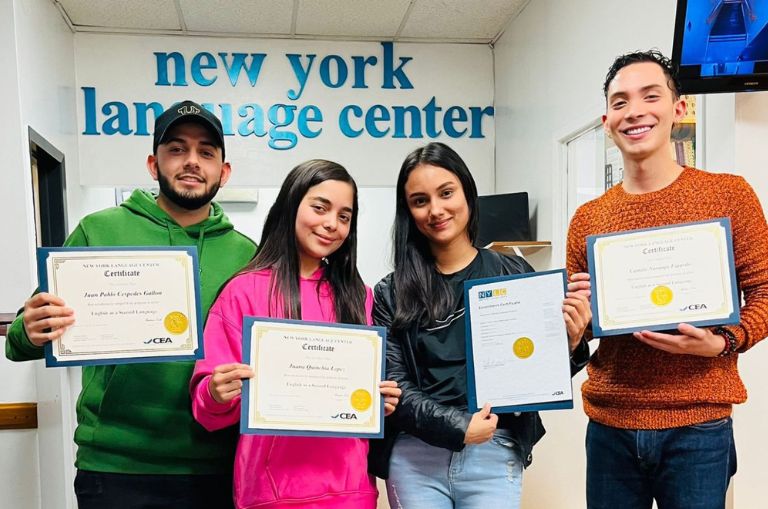

Supportive Learning Environment
NYLC is known for its warm, welcoming atmosphere where students feel comfortable, supported, and motivated to improve.
Communication-Focused Classes
Lessons are practical and interactive, helping students build confidence using English in real-life situations.
Experienced Teachers
Instructors guide students with clear feedback and engaging classroom activities so progress feels steady and achievable.
International Community in New York City
Students learn alongside classmates from around the world while enjoying the energy, culture, and everyday life of NYC.
New York Language Center
Our Courses
New York Language Center
Intensive Language Program Manhattan
NYLC’s Intensive Language Program is a practical, highly conversational ESL course designed to build real speaking confidence from day one. Classes emphasize oral fluency, active participation, and realistic speaking practice that mirrors everyday situations, helping students move from basic communication to confident, natural English use.

Course length
8, 12, 16, 20, 24, 48 weeks

Available starts
Students may join any Monday

Schedule (weekdays)
Available schedules: 9:00–2:00 / 10:00–3:00 / 1:00–6:00 / 4:00–9:00
Course hours per week: 20 hours per week

BEGINNER
Focuses on building foundational survival skills for students with little to no prior English exposure. The curriculum starts with the basics of the alphabet, numbers, and essential verbs—such as 'To Be' and the 'Simple Present'—to help students introduce themselves and navigate immediate ""survival"" situations in New York City. As students move through Level 1 and Level 2, they progress to practical vocabulary for daily life—such as shopping, directions, and time—enabling them to handle simple, routine tasks and exchanges. By the end of this stage, students are able to ask and answer basic questions about personal details and hold short, clear conversations regarding their environment and immediate needs.
INTERMEDIATE
Aims to transition students from basic communication to functional fluency across levels 3 through 6. The curriculum shifts toward mastering more complex grammatical structures and a wider range of idiomatic expressions necessary for richer, more meaningful conversations. Students work on narrative fluency, utilizing the past and future tenses to describe life events and personal plans with greater detail. There is a heightened emphasis on integrated skills, where listening and writing tasks are applied to professional and social contexts. By the end of the intermediate track, students can express nuanced opinions, participate in class discussions on cultural values, and produce well-structured texts for various personal and academic purposes.
ADVANCED
Focuses on achieving high-level operational proficiency and a near-native command of the language in Levels 7, 8, and Post-Advanced courses. The curriculum centers on refining complex grammar, sophisticated vocabulary, and subtle idiomatic usage required for specialized fields. Students engage with demanding, longer texts to recognize implicit meanings and practice rhetorical devices essential for fluent presentation. The term culminates in students mastering academic writing, including the structure of research papers and college-level essays, alongside high-level debates on world events. Graduates are equipped to communicate with precision and authority in both competitive professional environments and university-level academic settings.

New York Language Center
Intensive Language Program Queens
NYLC’s Intensive Language Program is a practical, highly conversational ESL course designed to build real speaking confidence from day one. Classes emphasize oral fluency, active participation, and realistic speaking practice that mirrors everyday situations, helping students move from basic communication to confident, natural English use.
Course length
8, 12, 16, 20, 24, 48 weeks
Available starts
Students may join any Monday
Schedule (weekdays)
Available schedules: 9:00–2:00 / 10:00–3:00 / 1:00–6:00 / 4:00–9:00
Course hours per week: 20 hours per week
1 week
to 3 months
to 3 months
3 months
to 6 months
to 6 months
6 months
to 9 months
to 9 months
9 months
to 1 year
to 1 year
1 week
$200
2 weeks
$400
3 weeks
$585
4 weeks (≈ 1 month)
$780
5 weeks
$900
6 weeks
$1,080
7 weeks
$1,260
8 weeks (≈ 2 months)
$1,440
9 weeks
$1,530
10 weeks
$1,700
11 weeks
$1,870
12 weeks (≈ 3 months)
$1,980
13 weeks
$2,145
14 weeks
$2,310
15 weeks
$2,475
16 weeks (≈ 4 months)
$2,560
17 weeks
$2,720
18 weeks
$2,880
19 weeks
$3,040
20 weeks
$3,200
21 weeks (≈ 5 months)
$3,150
22 weeks
$3,300
23 weeks
$3,450
24 weeks
$3,600
25 weeks
–
26 weeks (≈ 6 months)
–
27 weeks
–
28 weeks
–
29 weeks
–
30 weeks (≈ 7 months)
–
31 weeks
–
32 weeks
–
33 weeks
–
34 weeks
–
35 weeks (≈ 8 months)
–
36 weeks
–
37 weeks
–
38 weeks
–
39 weeks (≈ 9 months)
–
40 weeks
–
41 weeks
–
42 weeks
–
43 weeks (≈ 10 months)
–
44 weeks
–
45 weeks
–
46 weeks
–
47 weeks
–
48 weeks (≈ 11 months)
–
Registration fee
$200
Registration fee is not included in the price. Courses lasting 9 weeks or more do not require a registration fee.
Intensive Language Program Queens
Total course costs
Disclaimer: Prices are estimated based on the latest exchange rates.
Tuition fees do not include textbooks. Textbook fee is $45 per level (8-week level). A one-time application fee of $200 applies.
BEGINNER
Focuses on building foundational survival skills for students with little to no prior English exposure. The curriculum starts with the basics of the alphabet, numbers, and essential verbs—such as ‘To Be’ and the ‘Simple Present’—to help students introduce themselves and navigate immediate “”survival”” situations in New York City. As students move through Level 1 and Level 2, they progress to practical vocabulary for daily life—such as shopping, directions, and time—enabling them to handle simple, routine tasks and exchanges. By the end of this stage, students are able to ask and answer basic questions about personal details and hold short, clear conversations regarding their environment and immediate needs.
INTERMEDIATE
Aims to transition students from basic communication to functional fluency across levels 3 through 6. The curriculum shifts toward mastering more complex grammatical structures and a wider range of idiomatic expressions necessary for richer, more meaningful conversations. Students work on narrative fluency, utilizing the past and future tenses to describe life events and personal plans with greater detail. There is a heightened emphasis on integrated skills, where listening and writing tasks are applied to professional and social contexts. By the end of the intermediate track, students can express nuanced opinions, participate in class discussions on cultural values, and produce well-structured texts for various personal and academic purposes.
ADVANCED
Focuses on achieving high-level operational proficiency and a near-native command of the language in Levels 7, 8, and Post-Advanced courses. The curriculum centers on refining complex grammar, sophisticated vocabulary, and subtle idiomatic usage required for specialized fields. Students engage with demanding, longer texts to recognize implicit meanings and practice rhetorical devices essential for fluent presentation. The term culminates in students mastering academic writing, including the structure of research papers and college-level essays, alongside high-level debates on world events. Graduates are equipped to communicate with precision and authority in both competitive professional environments and university-level academic settings.
Registration fee
$200
BEGINNER
Focuses on building foundational survival skills for students with little to no prior English exposure. The curriculum starts with the basics of the alphabet, numbers, and essential verbs—such as 'To Be' and the 'Simple Present'—to help students introduce themselves and navigate immediate ""survival"" situations in New York City. As students move through Level 1 and Level 2, they progress to practical vocabulary for daily life—such as shopping, directions, and time—enabling them to handle simple, routine tasks and exchanges. By the end of this stage, students are able to ask and answer basic questions about personal details and hold short, clear conversations regarding their environment and immediate needs.
INTERMEDIATE
Aims to transition students from basic communication to functional fluency across levels 3 through 6. The curriculum shifts toward mastering more complex grammatical structures and a wider range of idiomatic expressions necessary for richer, more meaningful conversations. Students work on narrative fluency, utilizing the past and future tenses to describe life events and personal plans with greater detail. There is a heightened emphasis on integrated skills, where listening and writing tasks are applied to professional and social contexts. By the end of the intermediate track, students can express nuanced opinions, participate in class discussions on cultural values, and produce well-structured texts for various personal and academic purposes.
ADVANCED
Focuses on achieving high-level operational proficiency and a near-native command of the language in Levels 7, 8, and Post-Advanced courses. The curriculum centers on refining complex grammar, sophisticated vocabulary, and subtle idiomatic usage required for specialized fields. Students engage with demanding, longer texts to recognize implicit meanings and practice rhetorical devices essential for fluent presentation. The term culminates in students mastering academic writing, including the structure of research papers and college-level essays, alongside high-level debates on world events. Graduates are equipped to communicate with precision and authority in both competitive professional environments and university-level academic settings.
New York Language Center
Campuses & Location
Manhattan, New York
NYLC’s Manhattan campus is based on the Upper West Side, a leafy, residential part of the city that still feels unmistakably New York. You’re close to Central Park for study breaks and walks, and the area is packed with local cafés, delis, bookstores, and classic brownstone streets that make day-to-day life feel easy and safe.
It’s a great base if you want the “Manhattan experience” with quick access to museums, Midtown, and major NYC sights—without being right in the middle of the crowds.
~4 min walk to 103 St (1 train)
Queens, New York
NYLC’s Queens campus is in Jackson Heights, one of the most multicultural neighbourhoods in New York—perfect if you like an authentic, local NYC vibe. The streets around the school are full of international restaurants, bakeries, markets, and everyday city life, and it’s the kind of place where you’ll hear dozens of languages in a single walk.
It’s also a practical choice for students who want a well-connected area with a more “lived-in” feel than central Manhattan, while still being able to reach Midtown quickly by subway.
~3 min walk to 82 St–Jackson Hts (7 train)
Accommodation
Available accommodations

Homestay – $370/week (Sun thru Sat)
Homestay is a good option if you want a more local, supportive experience while studying. You live with a host family and get daily opportunities to practise English outside the classroom.

Dormitory – $2,500/month (4-week increments)
The dormitory option suits students who prefer more independence and a social, student-style living setup. Booking is charged monthly in 4-week blocks.
If you’re interested in exploring other accommodation options, please feel free to take a look at our other accommodation options.
Apply now
We are now accepting applications
New York Language Center
Student demographics
Students come from all over the world to study at this school.
Colombia
15%
Brazil
12%
China
10%
Turkey
8%
Mexico
7%
Japan
5%
South Korea
5%
Europe & Others
38%